
PLANT ENGINEERING
Complete charcoal and biochar production cycle
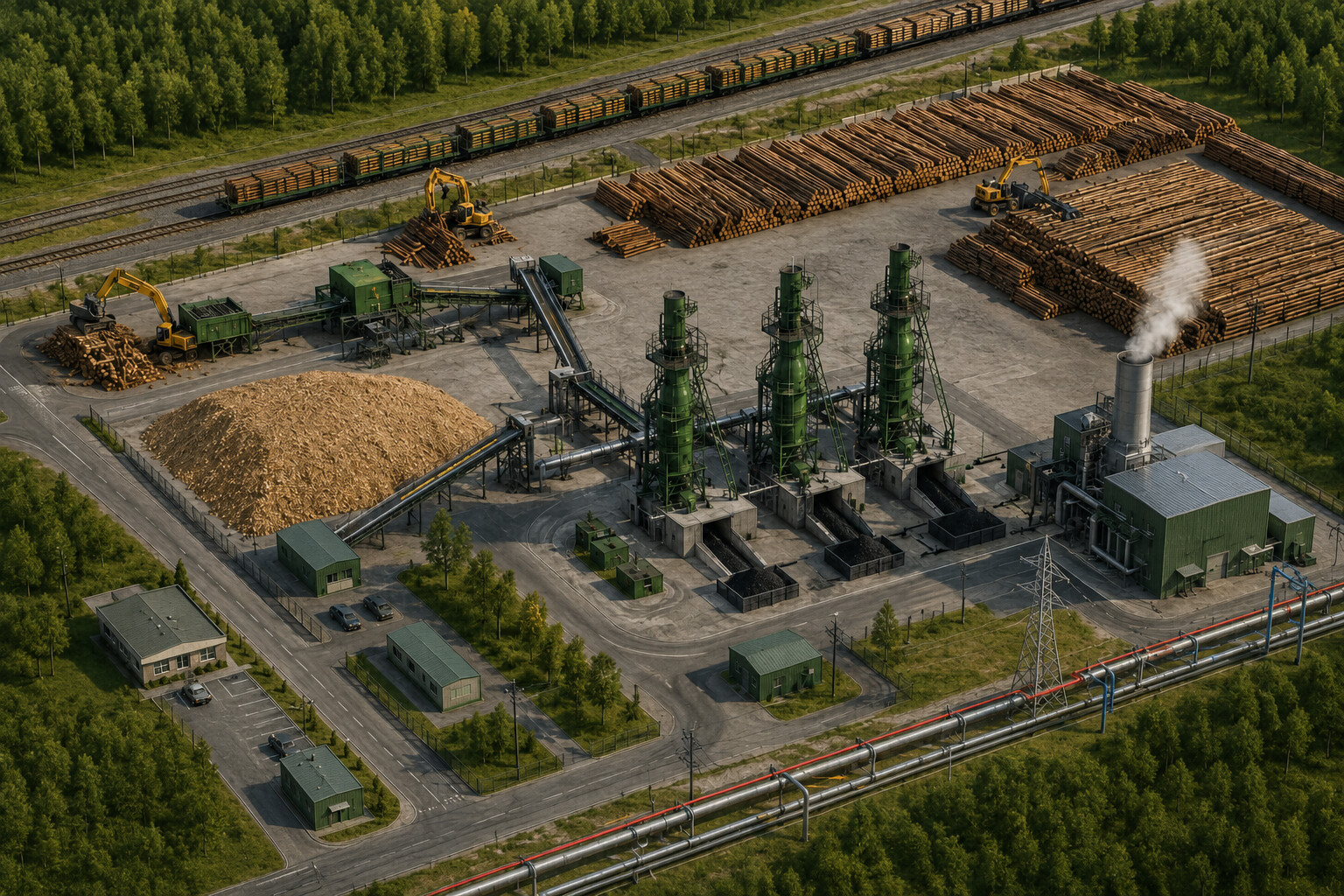
Industrial biocarbon production is one integrated chain—from receiving and preparing woody biomass to carbonisation, safe cooling, grading, packaging and use of pyrolysis energy.
01
One integrated process, not isolated machines
Charcoal and biochar quality begins well before the retort. Feedstock moisture, particle size and stable dosing determine thermal conditions, capacity and final product properties.
MAK GROUP engineers the plant as a connected system. Crushers, dryers, conveyors, retorts, coolers and packing equipment are matched through mass and energy balances to prevent bottlenecks and recover process heat.
02
Ten stages of the production cycle
Receiving and storage
Feedstock is received, weighed and stored according to type, moisture and required reserve.
Size reduction
Logs and wood residues are converted to the specified fraction and foreign material is removed.
Screening
Oversize and fines are separated to create a consistent material flow.
Drying
Moisture is reduced to the design range using recovered plant heat.
Metered feeding
Bins, conveyors and airlocks provide steady loading while limiting air ingress.
Carbonisation
Biomass passes through heating, pyrolysis and carbon formation in a continuous retort.
Energy circuit
Pyrolysis gas is collected and supplies heat to the retort and drying equipment.
Sealed cooling
Hot product is cooled without uncontrolled oxygen contact, preventing ignition.
Grading and control
Product is sized and tested for moisture, ash, volatile matter and fixed carbon.
Packing and fines recovery
Saleable grades are packed; fines are converted into briquettes or pellets.
03
Closed thermal circuit
The plant uses no external fuel. All thermal energy required for carbonisation is supplied by its own pyrolysis gas. The only imported energy is electricity for drives, fans, pumps, control systems and automation.
After internal needs are met, surplus heat can dry feedstock or supply industrial and district users. Electricity generation is possible with the appropriate configuration and a confirmed energy balance.
04
One process platform—two target products
Charcoal
Operation is selected for fixed carbon, volatile matter, mechanical strength and commercial size. The product serves as fuel, reductant and renewable industrial carbon.
Biochar
Carbon stability, porosity, safety, contaminants and intended use become central. Agricultural and environmental applications may require dedicated certification.
05
Project design inputs
01Biomass type, form and available volume
02Moisture and size range
03Required hourly and annual capacity
04Product use and specification
05Site plan, climate and logistics
06Available electrical capacity
07Potential surplus-heat users
08Environmental and permitting requirements
06 / FAQ
Frequently asked questions
Can one plant make both charcoal and biochar?
Yes, when the design and controls support different operating regimes. Feedstock, temperature profile, quality control and specification are nevertheless defined separately.
Which feedstocks can be used?
Split wood, prepared timber, wood chips, selected plant biomass and PKS. Suitability is confirmed by feedstock analysis and trials.
Does the plant require external fuel?
No. The plant uses no external fuel: its own pyrolysis gas provides all process heat. Only electricity is imported for drives, fans, pumps, controls and automation.
What happens to charcoal fines?
After grading, fines can be milled, blended with binder and converted into commercial charcoal briquettes or pellets.
Can surplus heat be sold?
Yes. With a stable heat balance it can supply dryers, industry, greenhouses or district-heating users.
MAK GROUP / ENGINEERING
Let us engineer your complete production cycle
Send us your feedstock data, target product, capacity and project country.
Let us engineer your complete production cycle→