
CARBONISATION TECHNOLOGY
How a continuous carbonisation retort works
A continuous retort converts prepared woody biomass into charcoal or biochar in a controlled, sealed process with managed temperature, residence time, gas flow and product cooling.
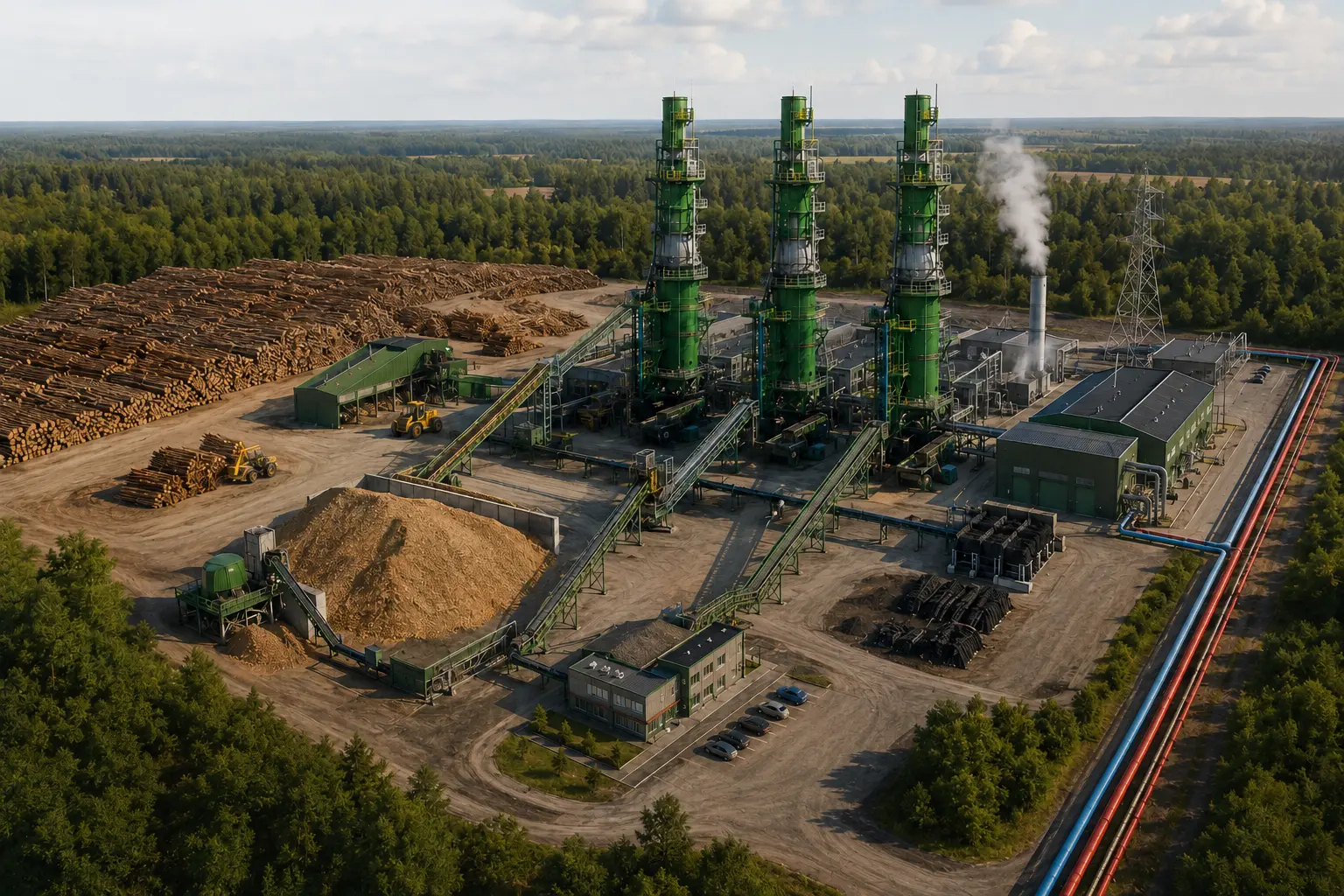
01
The continuous-process principle
Feedstock is metered into the top of a vertical retort while carbon product is continuously discharged below. It passes through heating, residual-moisture removal, pyrolysis, carbonisation and stabilisation zones.
Unlike batch kilns, a continuous system maintains a steady thermal state. Feed and discharge are synchronised, with parameters selected for wood species, particle size, moisture and product specification.
Carbonisation commonly operates around 400–650 °C, but the exact profile depends on design, feedstock and product purpose. Capacity therefore cannot be judged from vessel volume alone.
02
Main process stages
Feedstock preparation
Wood or chips are sized, cleaned and dried when required. Consistent particles support stable material flow and heat transfer.
Metered feeding
An airlock introduces feedstock while limiting uncontrolled air entry.
Heating and drying
Residual moisture is removed; recovered process heat can support upstream drying.
Pyrolysis and carbonisation
With oxygen restricted, wood decomposes into solid carbon, gas and condensable compounds.
Final residence
Temperature and residence time shape fixed carbon, volatile matter and product structure.
Sealed discharge and cooling
Hot product is cooled with limited oxygen contact to reduce ignition risk and carbon loss.
03
Pyrolysis gas and the energy circuit
Pyrolysis gas contains combustible compounds, steam, particles and condensable organics; composition varies with feedstock and operating conditions.
After particle separation and selected treatment, gas can enter a high-temperature combustion chamber. Its energy can support carbonisation, feedstock drying and external heat demand.
Where a stable surplus exists, the design may include boilers, heat exchangers or CHP. Electricity generation must be confirmed by a project-specific energy balance.
04
Continuous retort versus batch kiln
05
Information needed for a project
01Feedstock type, species and available volume
02Form: logs, chips, PKS or other biomass
03Moisture and particle-size distribution
04Required hourly and annual capacity
05Target charcoal or biochar specification
06Available utilities and possible heat users
07Climate, infrastructure, environmental rules and logistics
06 / FAQ
Frequently asked questions
Can one retort produce both charcoal and biochar?
Often yes, but operating conditions, feedstock and the target specification must be defined. Some biochar applications also require certification and additional quality control.
Can the plant operate without external fuel?
The plant uses no external fuel. All thermal energy required for carbonisation is supplied by its own pyrolysis gas. The only imported energy is electricity for drives, fans, pumps, control systems and automation.
Can wood chips replace logs?
Yes, when feeding, gas flow, material retention and cooling are designed for chips and the size and moisture remain within specification.
Can the plant generate electricity?
Yes, where a stable heat surplus and suitable CHP technology are available. The decision follows a detailed heat and power balance.
MAK GROUP / ENGINEERING
Let us configure the plant for your feedstock
Send us the feedstock, moisture, target product, capacity and project country.
Let us configure the plant for your feedstock→